


“The important thing about the Holy Week of Valladolid is the silence; a grieving, somber, and dense silence that covers and wraps a deep popular emotion.” –Miguel Delibes–
A silence, as Delibes states, that trespasses the limits of religions and turns into a cultural manifestation. Maybe this is what made the Holly Week of the Valladolid to be considered as International Tourist Interest in 1981, becoming one of the first cities of Spain with such distinction.

The history of Valladolid’s Holy Week begins in 1923, thanks to the archbishop Gandásegui, who not only promoted the recuperation of processions accompanied with historical fraternities but also fomented the creation of new ones.
A week of passion that begins on 14th and finishes on the 21stof April, and in which the sobriety is the protagonist of the processions, outstanding characteristic due to the quality and beauty of the parades exhibited on the streets during the designated days. The displayed carvings are realised by the best image makers, in which Gregorio Fernández, Francisco del Rincón, or Juan de Juni stand out.
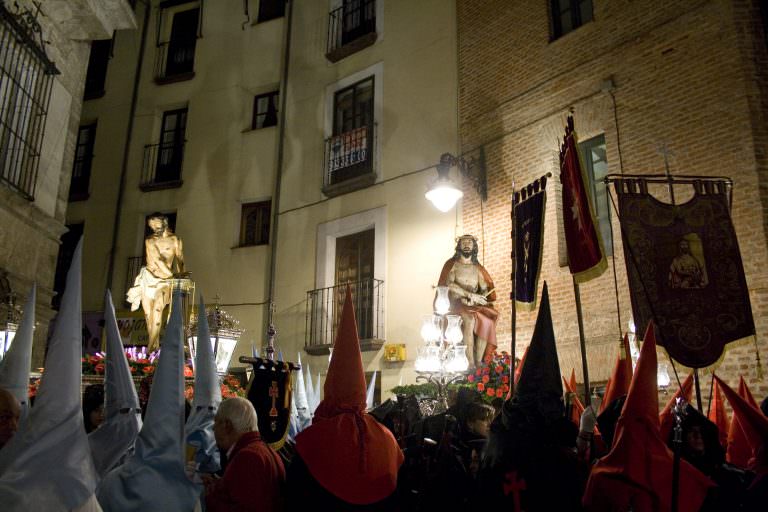
These pieces of art, preserved at the National Sculpture Museum or in the city’s churches during the rest of the year, go out to the streets thanks to the 21 fraternities of this city. These clusters are in charge of enlivening the images with fervor, devotion, and dedication. Some of them have been realizing this labour since the 15th and 16th centuries, being the fraternities La Pasión, La Vera Cruz, La Piedad, El Nazareno, and Las Angustias the most antique ones.

All the processions are distinguished for the devotion, silence, and spiritual retreat they incite on the believers, but the ones of “Encuetro” (Encounter), “Rosario del Dolor” (Rosary of the Grieving), or “Procesión General de la Sagrada Pasión del Redentor” (General Procession of the Sacred Passion of the Redeemer) are the most remarkable. Another event to highlight is the “Sermón de las Siete Palabras” (Sermon on the Seven Words), which is considered one of the more spectacular ceremonies of the city.
0“The atmosphere is our Holy Week’s most honourable thing of being admired of. Everything slides to a gloom that relieves the nerves, while beyond our heads it blows a spate of tragic pace. It is silence, spiritual retreat, intimal, and grieving awareness of the Great Sacrifice.” -Miguel Delibes-