


Valladolid’s Plaza Mayor, or Main Square, is one of the largest squares of Spain. It is located on its downtown, very close to San Benito Church and Santa María la Antigua Churches. It is a rectangular plan edification, presided by the monument of Count Ansúrez, the repopulator of the city.
During the 11th century, this city was a small agricultural village surrounded by a wall. The extension of the current square was outside the wall, very close to the Postigo del Trigo (Wheat’s Wicket), place in which the merchants traded their items.

In the mid- 13th century, the market was moved from the Saint Mary’s Square to Plaza del Mercado (Market`s Square), which, in the early 16th century, was named Plaza Mayor (Main Square), as it is known nowadays.
The square is completely arcaded and its porches are supported by granite columns. Since 1996, the facade surrounding Plaza Mayor has a very similar aspect to the original one, made of bricks. This was possible after a reform, which made it recover a very similar colour in relation to the brick-reddish colour that had been covered with concrete in the 19th century.
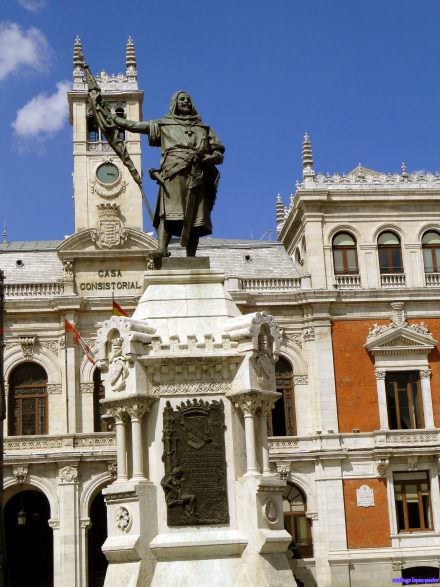
In the north of Plaza Mayor, there is the Council House, or Casa Consistorial, headquarters of Valladolid City Hall. In the centre of the square, there is a statue of the Count Pedro Ansúrez, repopulator of the city, realised in 1903. This bronze sculpture was erected by Aurelio Rodríguez-Vicente Carretero. The figure of the monument wears the characteristic clothes of King Alphonse VI’s period, a sword, and a shield. On his right hand, the Count holds the banner of Castile, and, on his left one, Valladolid’s founding document.
0