


The commonly known as the Cathedral of Segovia, Santa Iglesia Catedral de Nuestra Señora de la Asunción y de San Frutos, was built between the 16th and 18th century. It is characteristic due to its Gothic style combined with some Renaissance features, as well as its dimensions and elegance, which have given it the name of “Lady Cathedral.” This Gothic cathedral is one of the latest to be built in Spain and Europe since at the time of its construction, most of Europe had already entered in the Renaissance period.
Throughout history, there have been three cathedrals in Segovia: the oldest, known as “la primitiva” (the primitive) located in the Rivershore of Eresma river, was destroyed during the arianist persecution in 516. The second cathedral, known as “la antigua” (the old,) whose construction was ordered by Alphonse VII, was Romanesque, outside the Alcázar and consecrated in 1228. The current cathedral was a project of Charles I since the second was destroyed as a consequence of the Comuneros war in 1520.
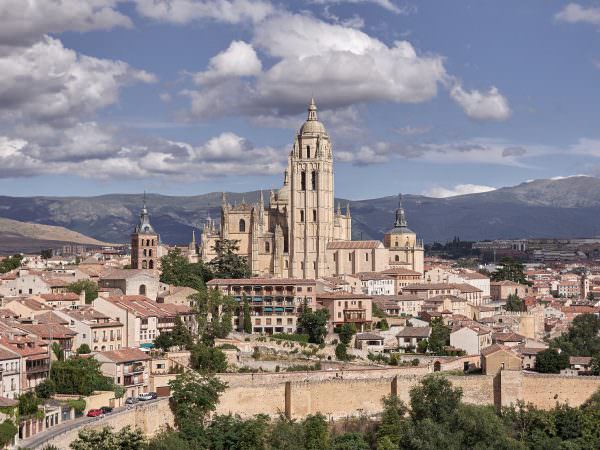
View from the Alcázar
The architect Juan Gil de Hontañón, who had already worked on the former Romanesque cathedral, was the first to be in charge of the construction. He died a year later and his son, Rodrigo Gil de Hontañón, took his place for three years.
Circa 1550, three naves and the tower were finished and even the cloister was relocated to the inside of the cathedral. Likewise, the chapter house was almost finished by then. In 1567, the construction of the crossing starts and the central nave is finished, allowing the opening of the cathedral in that same year.

View of Segovia, 1562
The current cathedral is 33 meters high, 50 meters wide and 105 meters long. It has three doors, the west door, called “puerta del Perdón”, the north door, called “puerta de San Frutos” and the south door, called “puerta de San Geroteo.” It is completely made of limestone and the sanctuary of the cathedral is located where Jews used to live.
One of the most beautiful things to see here is the inside of the main chapel. The construction of the altar was ordered by Charles III and designed by Francisco Sabatini. The main altar has a retable made of marble in different colors and bronze that resembles a Neoclassic structure.

Another worth seeing element are the stained glass windows, considered one of the biggest collections in Spain. It is made of 65 pieces divided in three depending on period of time they belong to: the first belongs to the 16th century and are one of the most important series of stained glass windows made by Pierres, both in Spain and Europe. The second belongs to the 17th century made by Francisco Herranz and the third belongs to 1916, which are 7 stained glass windows made by Casa Maumejean in Madrid.