


Burgos Cathedral is also known as Santa Iglesia Catedral Basílica Metropolitana de Santa María, a Catholic cathedral dedicated to Virgin Mary.
The history of this great cathedral started when the king Alphonse VI and the Pope Gregory VII appointed Burgos episcopal see in 1075. The king spurred the construction of the cathedral dedicated to Virgin Mary, which, despite the fact that its original designs remain unknown, it was supposed to be Romanesque, resembling all the contemporary buildings. There are documents that prove that the king donated the territory where the real palace, which belonged to his father Ferdinand, and a small church were located.
In 1096, the construction was already finished, but it soon turned out to be too small for the necessities of a city that was the kingdom’s symbolic capital. In the 13th century, it was decided that a new cathedral should be constructed. As it was usual at that time, the old building as well as a few houses nearby were demolished and the new Gothic cathedral was started be constructed instead.
The king Ferdinand III of Castile and the bishop Mauricio were present when the first stone was laid. The first to be in charge of the construction was an anonymous French architect. Around 1240, Maestro Enrique, also French, was put in charge, and will later be in charge of the construction of the Cathedral of León, which was undoubtedly inspired by the Cathedral of Reims. The construction was so quick that in 1238 the chancel, part of the crossing and the naves were already finished. Its consecration took place in 1260 even though the Divine Office has been recited there since 1230.

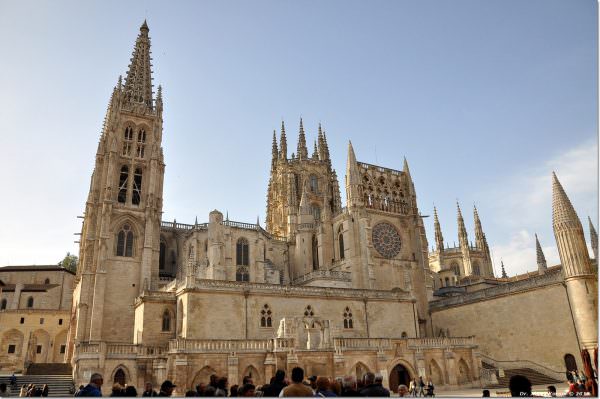
On the current day, the square base cathedral has three naves and two lateral towers. The spires of Germanic influence were added in the 15th century by Juan de Colonia. Also, the inside is inspired by the Cathedral of Bourges. The last elements to be constructed were the sacristy and Saint Tecla chapel in the 18th century, when the Gothic portals of the main façade were modified. The decorative elements and the inside’s furnishing belong to different artistic styles, such as Gothic, Renaissance or Baroque.
The Cathedral was designated National Monument in 1885 and World Heritage site in 1984. It is the only Spanish cathedral designated as such without being within the old town of the city. It is also the biggest Catholic temple in Castilla y León, and the only one that is a cathedral and a basilica at the same time.
In 1994, thorough restoration work started in the wake of the formerly detachment of one of the façade’s statue. Altogether, 30 millions of euros have been invested, making this cathedral the European monument that has received most money for its restauration and the one that took the longest.
One of the biggest Burgos Cathedral’s attractions to visit, besides the building itself, is the crossing’s floor. Right below the lantern tower, El Cid and Doña Jimena’s sepulcher is located since 1921. Their remains, which used to be located in San Pedro de Cardeña monastery, were buried under a marble slab during a solemn ceremony.

0