


The San Pedro de Arlanza Monastery is situated in Sierra de las Mamblas, in Hortigüela’s term, in the South-east of Burgos.

The riuns still show the brilliance of this Benedictine monastery.
Located in Burgos’ province, the Arlanza River surrounds the ruins of the historic San Pedro Arlanza monastery, an artistic testimony of Romanesque architecture. On January 12, 912, it was founded by Count Gonzalo Téllez and his wife Miss Lambra, who dedicated it to Saint Peter on 12 January of the year 912.
When getting closer to the entrance of this superb monastery settled on a rocky promontory, near the village of Hortigüela, Burgos, the visitors of these impressive ruins become charmed in the presence of the majesty that still reaches its walls and rooms in ruins. Since the year of its construction in 912, these walls have been the silent witness of nearly a thousand years of Castilian history.
For this reason, it became and was named “the Cradle of Castile” in the past. There is also a legend related to this denomination, linking the splendour of Castile with that of the monastery in such a way that the recovery of one would be the recovery of the other one.
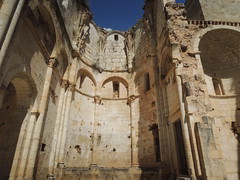
Interior of the Benedictine monastery.
Surrounded by the Arlanza River, it had a symbolic value in the formation of the Castilian kingdom, and although its first remains, which are still visible, date back to the year 1080, the congregation was founded in 912 as a hermitage but its functionality ended 1835 due to the Mendizabal Disentailment. At that time, the congregation abandoned its outbuildings in which the Romanesque temple’s plant and the late Romanesque influence could be admired. In like manner, there still are reminiscences of the pre-Romanesque styles in both its chequered or zoomorphic capitals and its truncated scrolls.
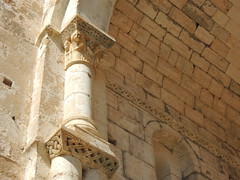
One of the lacerated capitals that are preserved in this place.
0