


The Museum of Human Evolution located in Burgos is not only one of the most visited museum in Castilla y León, but also in Spain. Only during its first year it received 279,000 visitors. It is a part of the regional museums web of Castilla y León, along with the Ethnographic Museum of Zamora, the Museum of Contemporary Art and the Museum of Steelmaking and Mining, both located in León.
MEH —the acronym used to refer to it, which stands for “Museo de la Evolución Humana”— was designed by Juan Navarro Baldeweg. Its construction took place where centuries ago the now missing Dominican San Pablo convent was located. The current building stands out for its wide dimensions and its crystal façade, that in the east and west sides have a red metallic structure, that are one of its symbols. One of the main advantages of using crystal is the brightness that illuminates it, which makes it seem more ample and reduces the energy consumption. The entrance to the museum is placed in a ramp from Paseo Atapuerca, a spacious pedestrian zone with garden that allows to descend to the riverside of Arlanzón.
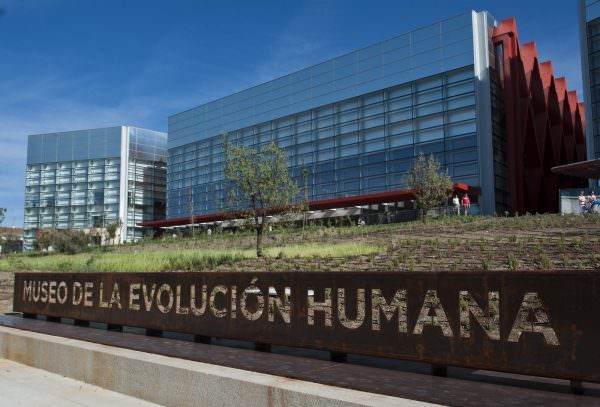
Its objective is to create a project linked to the necessity of conserving, inventorying and publicizing the archeological remains found in the archeological site of Atapuerca. It has established itself as a referent related to mankind’s evolutionary process in the environmental, biological and cultural aspect in chronological order. It has more than 25 large-format projectors, 360º circular projection, interactive screens, and more than 50 video sources. All systems are controlled and automatized, as well as synchronized with special effects.
The inside of the museum is distributed in particular way: it recreates the mountain range of Atapuerca. In the first floor, the archeological and paleontological facility of the archeological site of Atapuerca is located. Moreover, it is also exposed in a practical way, why we are so alike to the hunter-collector that lived 9,000 years ago. The ground floor is dedicated to Darwin’s Theory of Evolution and the history of human evolution. It also has 10 hyperrealist reproductions of the ancestors of mankind, as well as an imitation of the stern of the HMS Beagle, ship that Darwin used during his famous 5 year voyage around the world. And finally, in the second floor, the three essential ecosystems for human evolution are recreated: the jungle, the savannah and the steppe of the last glaciation.
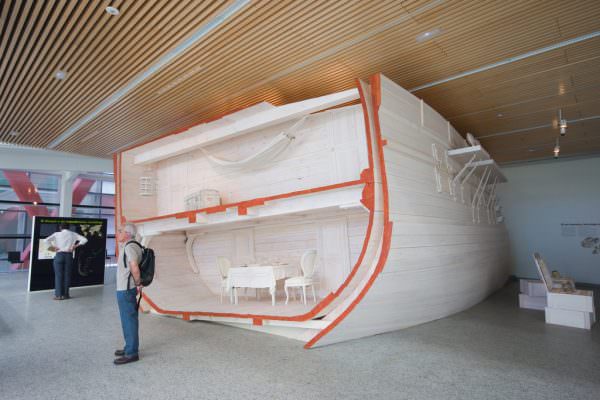
Imitation of the stern of the HMS Beagle
The museum has been awarded more than 40 national and international prizes. Furthermore, in 2015 it was designated World Heritage site along with the archeological site of Atapuerca. The Museum of Human Evolution is included in “Sistema Atapuerca” that comprises various visits outside the facility of the museum: the archeological site of Atapuerca, its archeological park and the Esperanza mine.
0