


Las Médulas was the biggest gold open-pit mine of the Roman Empire. Both human and natural actions have turned this area into of the most charming and interesting landscapes of the Iberian Peninsula. It was designated World Heritage site in 1997, and a year earlier it had been also designated Bien de Interés Cultural due to its archeological interest. In 2002, it was designated Natural Monument and Tripadvisor declared it was one of the most breathtaking natural spots out of ten in Spain.
This landscape is located in El Bierzo, León. It was given the name of Las Médulas because in the traditional language that is spoken in that area, which is still in use, there are words such as “meda” or “medar,” which means a stack of soil of conical shape and pile up soil, respectively. Also, “medeiro” means a dune, or a heap of sand, and belongs into the same “family” of the Spanish word “médano” according to experts.
Originally, Las Médulas was a Roman mining, which probably started to be mined during Augustus’ leadership, who personally was in charge of the conquest of the northern part of the Iberian Peninsula between 26 and 19 BC. Although it is likely that indigenous people before the Romans had already mined the field. Currently, there is a quarry that, despite having been declared illegal in 2008, it is still active in its surroundings.
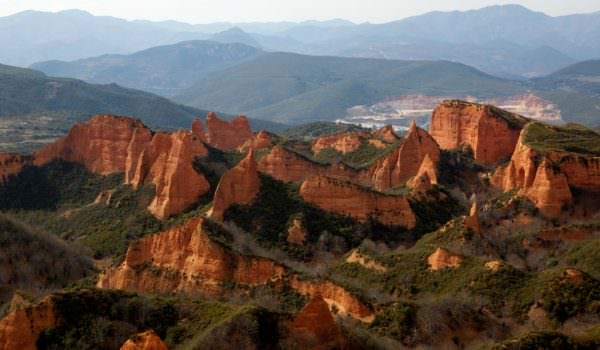
The formation of the landscape we can see today lasted centuries, after its abandonment in the 3rd century, the native vegetation such as oaks, evergreen oaks, and chestnut trees quickly took over the place. This caused the emergence of this amazing landscape characterized by the irregular land. As well as the red sand, which blends entirely with the vegetation. In order to get to Las Médulas, we must get to Carucedo, in El Bierzo. Once there, we turn left where the turnoff leading to the dunes is signposted. In case you decide to go straight, to the right you will get to the lake of Carucedo and to La Casa del Parque. There two possible routes to take:
- Las Médulas route: going through Ponferrada and the alluvial plains of Villalibre de la Jurisdicción (Priaranza del Bierzo,) we will soon find the escarpment of Santalla del Bierzo y Borrenes, in whose surroundings the Castle of Cornatel and Villavieja is located. We need to get there in order to get near to the lake of Carucedo, from where you can take the turnoff that leads to the village of Las Médulas, so that you can get to the field. If you decide to take this route by foot, you will get the chance to visit the caves of La Encantada and La Cuevona.
- Las Medilillas route: in Orellán, a village where used to be a Roman hillfort, there is a path towards the Orellán viewpoint, accessible by car. Once there, you have to continue by foot bordering the Placias Mountain to Campo de la Braña, where the path goes down to the excavation of las Medulillas in the caves of Reirigo or La Chaira. This path also leads to the fork of las Pedrices, where you can go back to Las Médulas. Furthermore, right beside the viewpoint, there are some tunnels that you can visit.
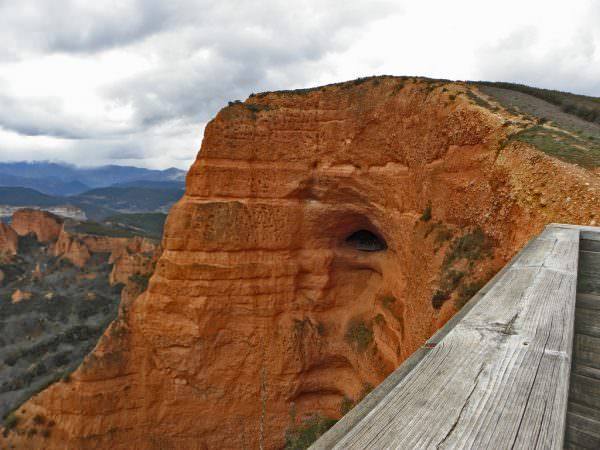
Orellán viewpoint