


Santa María de Regla Cathedral is a Catholic temple dedicated to Virgin Mary and episcopal see of the diocese of León. It was the first Spanish monument to be designated as such in 1844.
Its construction started in the 13th century following the Gothic style, and it is also the “most French” of the Spanish cathedrals of the 13th century since it was clearly inspired by Reims Cathedral as it can be seen in the floor plan.
It is also known as pulchra leonine which means “beautiful lioness” and it is located in the path that Way of Saint James has in León. Its outside is magnificent, with its impressive towers and its portal representing Doomsday, Saint John and Saint Francis. However, the most remarkable feature is the immense polychrome stained glass windows that take up most of the wall’s space and are considered to be one of the biggest medieval collections in the world.
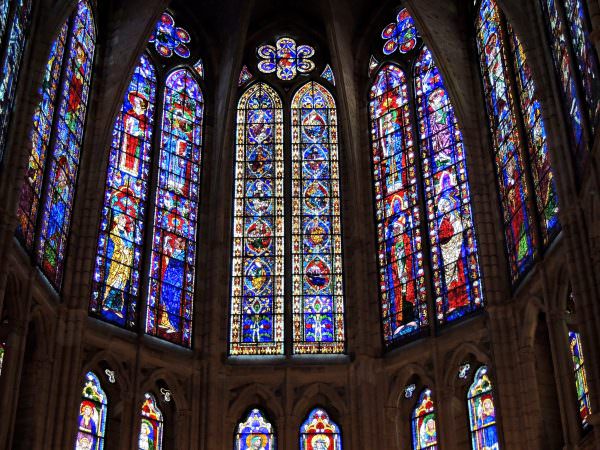
As it is characteristic of the Gothic architecture, sculptures are not inside the cathedral —but are placed on the outside, on the façades and doors, instead— and the aniconic capitals that do not represent the image of divine figures, prophets or any religious character.
The large Gothic building we get to see today replaced another smaller Romanesque temple built next to the wall in the 12th century. Similarly, that temple was replaced by Roman thermaes in the 2nd century.
Circa 1275 the construction of the current Gothic cathedral started during the bishopric of Martín Fernández, even though the project was already created during the former bishopric. The architect named Simón was at first in charge of the construction, later on he was replaced by Enrique, who also intervened in the construction of the cathedral of Burgos, and the last one to be in charge was Pérez, who worked on it until the 13th century.
The main building was already finished by 1301, the cloister was finished from the late 13th century to the first decades of the 15th century, and the towers were not built until the 16th century. In the 17th century, some of the domes collapsed and they had to be replaced by a Baroque dome. Juan Madrazo removed that dome in the 19th century and worked on a project inspired by the work of the well-known architect Viollet-Le-Duc. However, it was eventually finished by Demetrio de los Ríos, and in 1901 the cathedral opened again.
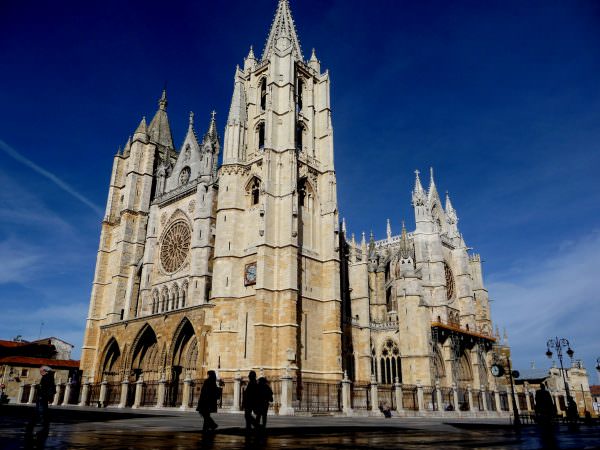
A great deal of scholars affirm, without downplaying other Spanish cathedrals, that if you want to be acquainted with the essence of the European Gothic in the 13th century, you must visit the inside of this cathedral.
León is the Roman and medieval city that nowadays would not be the same without this majestic building.